
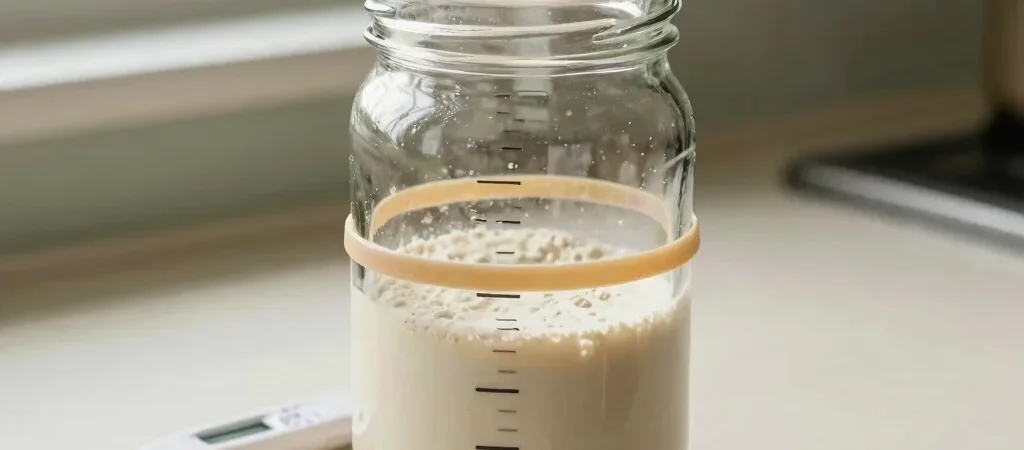
You feed your starter, mark the jar, and come back hours later to find the line barely moved. Before adding more flour or starting over, check the temperature and the pattern of its recent feedings. A starter responds to both, and changing one thing at a time gives you a clearer read.
Check the spot before the recipe
Room temperature is not always starter temperature: a jar on a cool stone counter can be much colder than the room. A steady, comfortably warm spot around 24–27°C (75–80°F) can encourage activity, while cooler conditions often slow it down. Keep the jar away from direct heat, which can warm it unevenly.
Make the next feeding easy to compare
For a clear baseline, weigh equal amounts of starter, water, and flour—for example, 20 g of each. Mix well, mark the starting level, and note the time and temperature. Use the same flour and ratio for the next feeding so you can compare the rise rather than guess at several changes.
Look for a pattern, not a deadline
Watch for bubbles throughout the starter and a rise above your mark; the timing will vary with temperature, flour, and starter strength. If it is still slow, keep the conditions steady through another feeding or two before adjusting the ratio. A brief note in a feeding tracker can reveal a pattern that is easy to miss from memory.